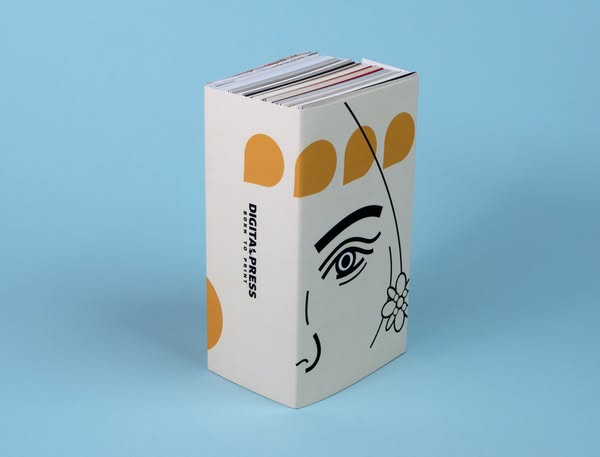
Our paper catalog is carefully curated to showcase not only the full range of sheet and roll substrates we offer, along with their weight variations, but also the results achievable with our printing technologies on each substrate.
We printed the same design on every substrate to make it easy for you to compare them. This highlights which papers are better suited for text or line art rather than tone-rich, gradient-heavy designs. The reason lies in the substrate’s surface smoothness—while textured papers can be striking and unique, they don’t always perform perfectly with digital printing.*
This also applies to spot colors. Clear varnish, white, silver, or gold may look vibrant on some substrates but barely noticeable (especially varnish and white) or dull on others, failing to achieve a metallic effect. We’ve accounted for this in our calculator’s programming, so if a spot color isn’t available for a selected substrate, it’s not recommended for that material.
Another important consideration is substrate availability. Although our production management system tracks paper stock and usage down to the sheet, we cannot always prevent in-person orders from depleting stock needed for online orders. Substrates expected to be unavailable for an extended period are disabled in our system.
It’s also worth noting that the color and surface texture of papers can vary slightly. Paper production isn’t an exact science with consistent outcomes, so slight differences in color shade or embossing may occur compared to previous batches.
Finally, we must address the unfortunate situation when a paper type is discontinued. This can happen due to a manufacturer’s portfolio change, the unavailability of a raw material (e.g., “seals no longer produce green fibers”), or the cessation of European distribution (e.g., Mohawk). As passionate paper enthusiasts, we go to great lengths to source these materials, ordering from the U.S. or Japan or traveling to Germany. The most challenging scenario is when a paper mill closes, as happened recently with Arjo Wiggins, the beloved producer of Conqueror, Curious, Keaykolour, and Rives papers. While Antalis has taken over and continues producing much of their portfolio, and Europapier offers similar papers, there may be slight differences from the originals, and many unique papers were not preserved.